


The post that looked healthy but wasn’t earning
Pull up any backlog of affiliate posts and you will find at least one that passes every quick check. It still gets visits. It still shows up somewhere on page one for its main keyword. Nobody flags it as broken because nothing about it looks broken. The traffic graph is flat instead of collapsing, which is exactly why it gets ignored: a page that drops to zero visits gets noticed. A page that keeps pulling a steady trickle of visits while the commissions dry up does not.
That is the page worth examining first in any audit, not the ones already in free fall. A comparison post built around two products in a saturated category is a good example of the type: decent word count, a table, a handful of affiliate links, ranking somewhere between position six and position twelve for its target phrase. The pageviews hold up month over month. The problem only shows up once you stop looking at pageviews and start looking at what happens after someone lands.
This is the gap that matters for anyone sitting on a backlog of twelve, fifty, or two hundred posts: traffic and earnings are not the same metric, and a dashboard that only surfaces the first one will let a dead page hide for a very long time.
Pulling the numbers that actually matter
Pageviews answer one question: did the content get found. They say nothing about whether it did its job once it was. Three other numbers tell you that, and none of them live on the same screen as your visit count by default.
Keyword rank for the actual buying query. Not the broad head term, the specific phrase someone types when they are close to clicking “buy.” A page can rank well for an informational variant of its topic while losing ground on the commercial one, and that split is invisible until you check both separately.
Click-through rate on the affiliate links themselves, not just sessions on the page. A post can hold its traffic while its link click rate quietly drops, usually because the offer, the button copy, or the positioning on the page has gone stale relative to what a reader now expects. If you are not already pulling this number at the link level rather than the page level, how to track affiliate clicks and conversions walks through setting that up properly.
Conversion rate on whatever happens after the click, meaning the vendor’s own reporting or your network dashboard, not your own analytics. This is the number that actually ties back to revenue, and it is the one most backlogs never check post by post because it takes more digging than the other two.
A page that is bleeding on all three of these is dying. A page that is still fine on rank and click-through but has lost conversion because the offer itself changed is a different problem entirely, and it needs a different fix.
Three signs a page needs a rewrite instead of a redirect or a deletion
Not every underperforming post deserves the same treatment. Some should be merged into a stronger page and redirected. Some genuinely have no reason to exist anymore and should come down. The rest are worth rewriting, and the signal for which bucket a page belongs in comes down to three checks.
- It still ranks, just not well enough to convert. If a page sits on page one or close to it but the click-through and conversion numbers are weak, the content has an audience problem, not a discovery problem. Rewriting gives you a shot at fixing both rank and conversion at once. Deleting it throws away ranking signal that took time to build.
- The topic still has active search demand. Check this before committing to a rewrite. A page can be perfectly well written and still be dead weight if the query it targets has genuinely dried up, in which case no amount of editing brings it back. Semrush versus Ahrefs covers how to check current search volume against what a keyword was pulling when the page was first written, which matters more than it sounds for anything published more than a year ago.
- The gap is fixable with information you actually have. If the page is underperforming because the comparison table is stale, the pricing is wrong, or the affiliate link points at a discontinued offer, that is fixable. If it is underperforming because the entire premise of the post no longer matches how people search for the topic, a rewrite will not save it. That page needs a redirect into something built around the current intent instead.
A page that fails the first check, meaning it has lost rank entirely and shows no recovery in search console over several months, is usually a deletion or a consolidation candidate. A page that passes all three is worth the time.
What the audit found: stale comparisons, dead offers, and a mismatched search intent
Once a page clears those three checks, the actual audit is narrow. You are not rereading the whole post for tone or looking for typos. You are hunting three specific failure modes, because in practice almost every underperforming-but-salvageable page has one or more of them.
Stale comparisons. A table built around pricing tiers, feature sets, or version numbers that have since changed. Readers notice this faster than analytics do. A comparison post that still describes an old pricing structure reads as untrustworthy the moment someone checks the vendor’s actual site, and that mismatch kills conversion even if the page still ranks.
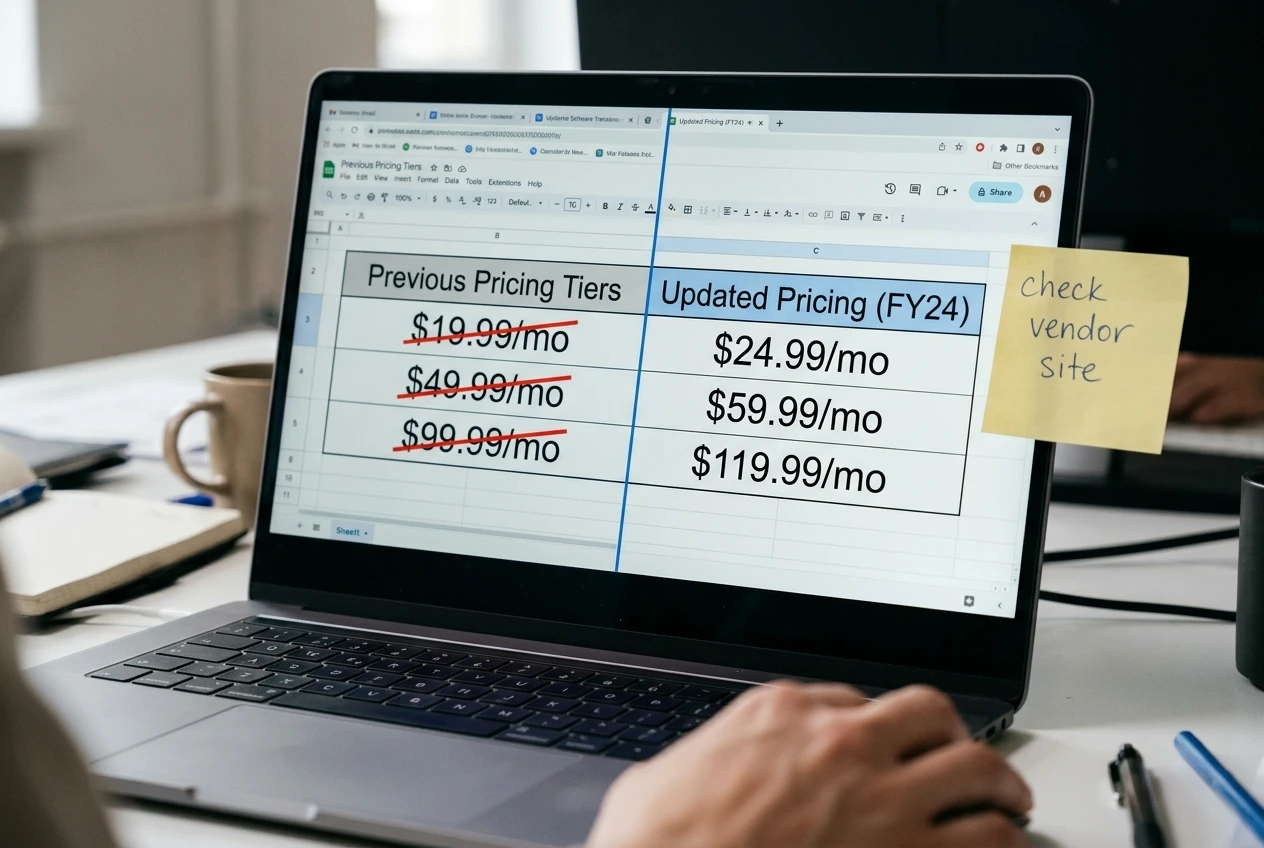
Dead or de-prioritized offers. An affiliate link pointing at a program that has lowered its commission, added new restrictions, or simply stopped being the best option in its category. The link still works. It just no longer leads anywhere worth sending traffic.
Mismatched search intent. This is the subtler one and the most common reason a page ranks fine but converts poorly. The post was written to answer one question, but the query it now ranks for has shifted toward a different one. A page written as a general introduction to a topic, ranking for a query that has become more comparison-driven over time, will keep its traffic while losing its clicks, because the page answers a question the searcher already moved past.
Flagging which of these three applies to a given page is most of the diagnostic work. The edits that follow are directly tied to whichever failure mode you find.
The specific edits made: restructuring the page, updating claims, and relinking affiliate products
Each failure mode gets a specific fix, not a general rewrite.
For stale comparisons, the fix is updating the actual data points: current pricing, current feature lists, current version numbers, pulled from the vendor’s live page rather than from memory or from the original research. A table with outdated numbers is worse than no table, because it actively damages trust once a reader spots the discrepancy.
For dead or weakened offers, the fix is swapping the affiliate link and the surrounding copy together, not just the URL. If the new offer has a different structure, different proof points, or a different call to action, the paragraph around the link needs to match it. A link swapped in without touching the copy around it often undersells the new offer relative to the one it replaced.

For mismatched intent, the fix is structural. This usually means moving a comparison table higher on the page instead of burying it under three paragraphs of introduction, adding a direct verdict section near the top for readers who want the answer without the full read, and cutting background information that the current searcher already has. This is the edit that takes the longest, because it is not a line-by-line update, it is a rebuild of the page’s order of information to match what the current search intent actually wants first.
Across all three, the affiliate links themselves get re-evaluated against what is genuinely the stronger option today, not what was strongest when the page was first published. A rewrite is also the moment to check disclosure placement, since restructured pages sometimes end up with the disclosure buried below a moved table or pushed past the first scroll. The disclosure placement playbook covers where it needs to sit so that update does not quietly undo itself.
What changed after republishing, and over what timeframe
Rewrites built around these three fixes do not produce overnight results, and treating the first week after republishing as a verdict is a common mistake. Search engines take time to recrawl and re-evaluate a changed page, and rank movement on a competitive commercial query typically shows up over weeks rather than days. Conversion data moves faster than rank, since it depends only on the people already landing on the page, but even that needs a few weeks of volume before it is a reliable read rather than noise.
The realistic pattern to expect: click-through on the affiliate links tends to move first, often within the first couple of weeks, since it depends entirely on the page itself rather than on search engines recrawling it. Rank movement follows later and is less predictable, since it also depends on what competing pages are doing in the same window. Judging a rewrite on seven days of data will almost always undersell it or oversell it. A month is a more honest minimum before deciding whether the edit worked.
Building a simple scorecard to run this same audit on your own backlog
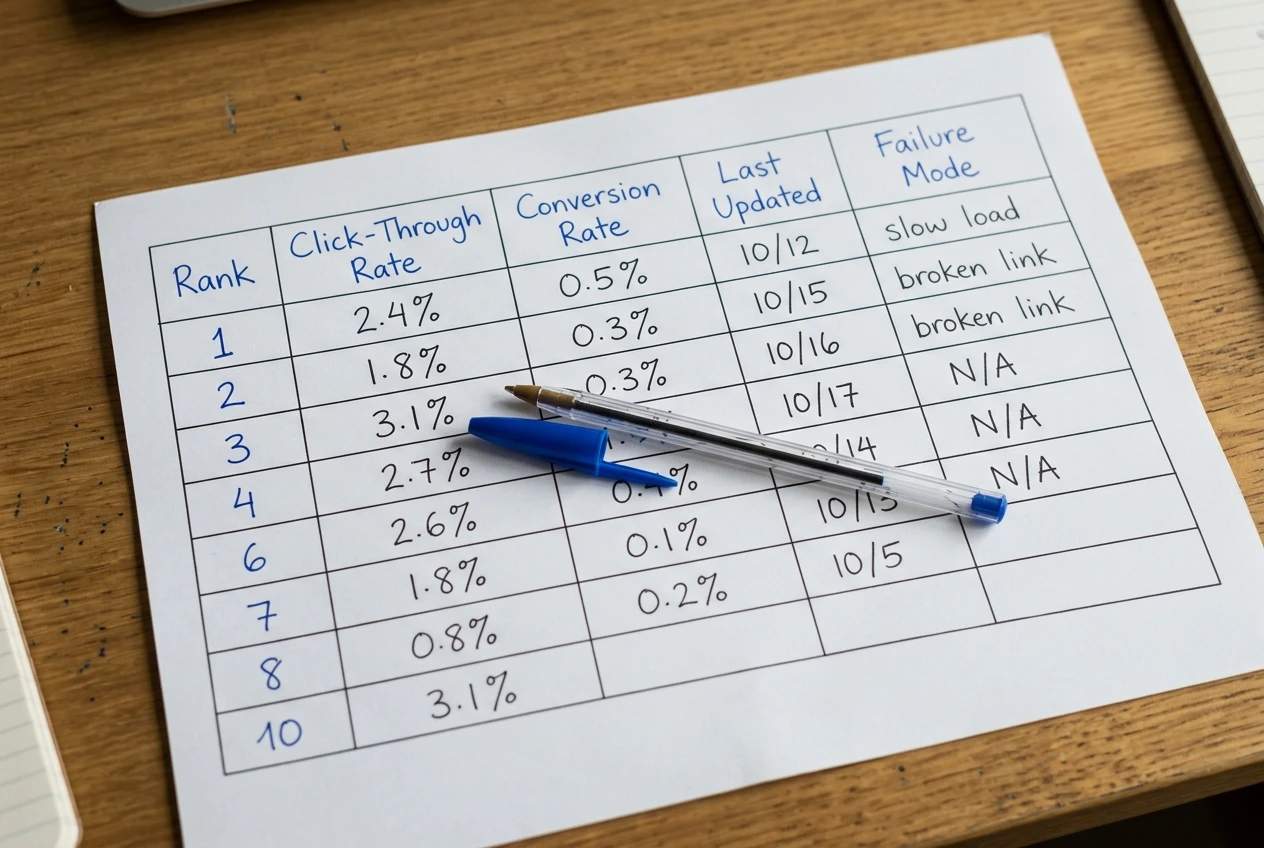
The method above only works if it is repeatable across a full backlog, which means it needs to fit on something simpler than a spreadsheet full of formulas. A workable scorecard has five columns per post: current keyword rank for the buying query, link-level click-through rate, downstream conversion rate from the network or vendor, age of the last content update, and a one-line note on which of the three failure modes applies, if any. Score each post on those five and the rewrite-versus-redirect-versus-delete decision mostly makes itself.
Run this same scorecard against your own lowest-traffic posts this week, starting with anything older than twelve months, and use the Writer in Studio to draft the rewritten sections once you’ve flagged what’s stale.